Developed as the basis for Freud’s psychoanalytic theory, the id, ego and super ego are thought to be the foundations of the mind- our decisions, behaviors, and actions. Thus, understanding this theory can help one better understand self and interact more effectively with the world for the purpose of having a greater impact. Having an understanding of this theory may also contribute positively to personal development and pave the way for a more prosperous future through making appropriate character adjustments to better interact with self and others. This could assist with increasing overall satisfaction with self through understanding and compassion.
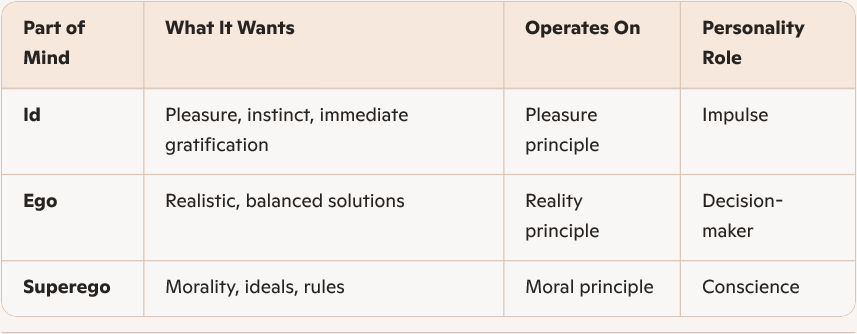
The id is thought to be the “inner child” of the mind. Focused on instant gratification and the pleasure principle, the id is driven by instinct and impulse with little regard for rules, consequences or the forces of reality- that is why the ego is vital. Known as the “inner mediator,” the ego manages the id’s impulses through the reality principle and tries to satisfy the id using realism and socially acceptable strategies like proper decision making, planning and weighing cost effectiveness. This leads us to the super ego- the “inner parent.” This aspect of the mind is thought to represent morality, rules and values. Pushing one towards what is “right,” “good,” or “ideal,” the superego creates feelings like pride when you meet standards and guilt when you don’t- often thought to internalize the constant narrative of parents, teachers, spouse(s), culture, religion, etc.
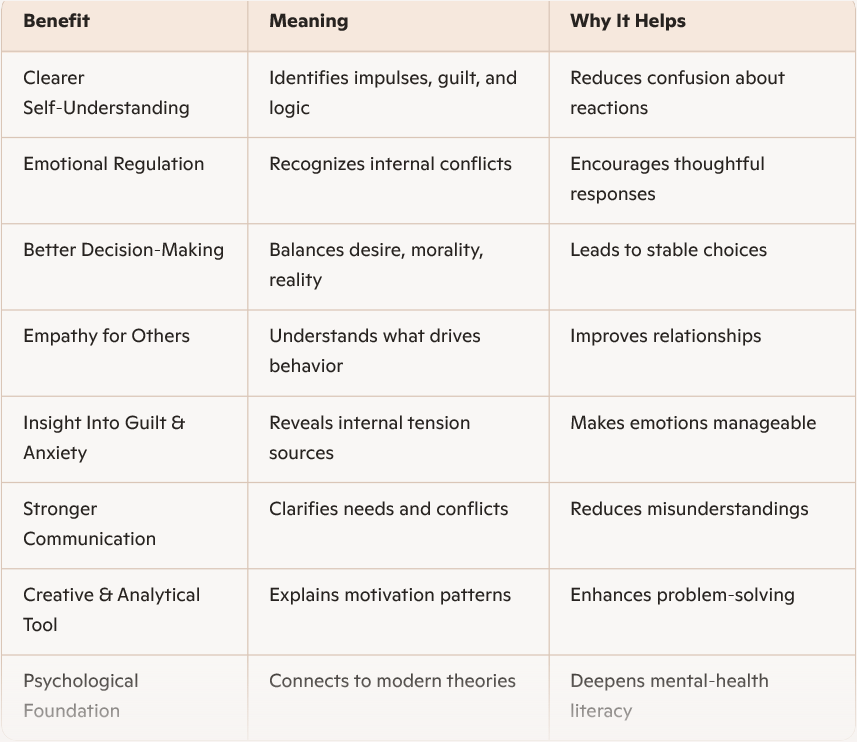
The understanding of this theory becomes beneficial when longing to grow in connection to self through analyzing one’s own logic. This skill assists with emotional regulation, better decision-making, and empathy for others through stronger communication. To make the importance of understanding this theory clearer, I have collaborated with Copilot AI Companion to generate the following graph. Please enjoy:
In summation, when one grows in love for self through understanding and compassion, that positive shift impacts more than the individual- it benefits relationships, personal growth, and the world. We all have the opportunity to create a legacy of positive change that starts within. Be blessed and be a blessing!
APA Work Cited for above information:
Freud, A. (1936). The ego and the mechanisms of defense. International Universities Press.
Freud, S. (1923). The ego and the id (J. Riviere, Trans.). W. W. Norton & Company. (Original work published 1923)
Hall, C. S. (1954). A primer of Freudian psychology. Meridian Books.
McLeod, S. (2019). Id, ego and superego. Simply Psychology. Id, Ego, and Superego
 Superb Lifestyle: Fitness, Fashion, Photography, Mindfulness & More.